
by Jarrett Hoffman
 After COVID struck, the Rocky River Chamber Music Society was one of the area’s first organizations to set up a live-streamed concert, the Society’s season finale in May.
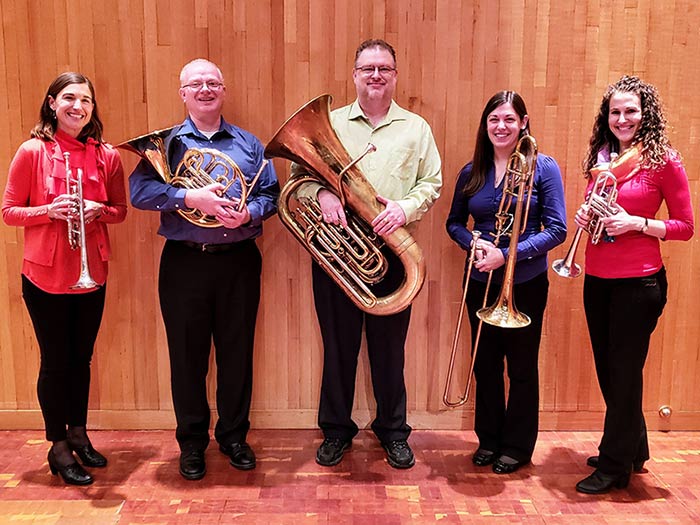
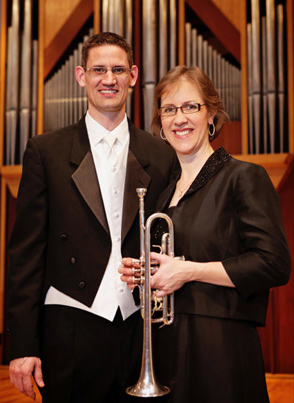
One of the performers that night was trumpeter and board member Amanda Bekeny, who now brings her Diamond Brass Quintet colleagues to West Shore Unitarian Universalist Church to open the series’ 62nd season on Monday, October 12 at 7:30 pm.
Joining Bekeny will be trumpeter Nina Bell, hornist Greg Hills, trombonist David Mitchell, and tubist J.c. Sherman. Their program, live-streamed only, will include works by J.S. Bach, Victor Ewald, Stravinsky, Eric Ewazen, and Anthony DiLorenzo, and can be accessed on Facebook or YouTube.
Phenomenal player, great teacher, superstar freelancer: those are the words that RRCMS music director Dan McKelway used to describe Bekeny back in May.
I’ll add to that a few adjectives of my own. First, humble — the trumpeter gave a hearty laugh after I shared McKelway’s “superstar” compliment. And second, down-to-earth — after a very short delay at the start of our Zoom call, she explained that she hadn’t had the right TV show on for her 3-year-old. (Apparently, Daniel Tiger’s Neighborhood wasn’t good enough.)
 When live music as we know it came to a halt at the start of the pandemic, clarinetist and Rocky River Chamber Music Society board member Daniel McKelway knew he wanted to do something for concertgoers who live in retirement communities in the area.
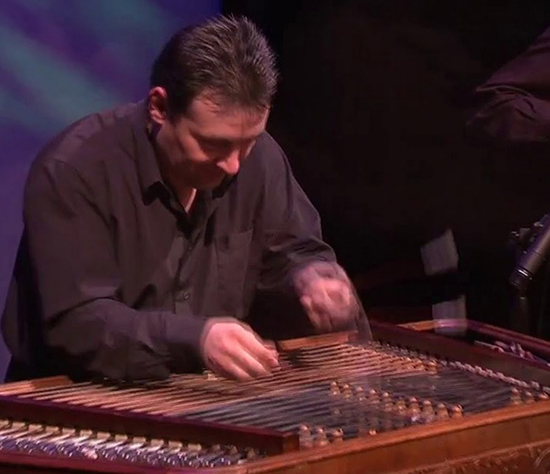 The music of Hungary occupies a unique place in the world of classical music. Musicians active between the mid-1800s and early 20th century understood the nation as either a land of best-kept secrets and hidden musical diversity, or as a foreign wonderland where exotic dance tunes and virtuosic fiddling occupied a lonely throne. In a recent concert, cimbalom soloist Alexander Fedoriouk and members of The Cleveland Orchestra explored both sides of the old divide: the Hungary that one expects and the richer, stranger version as well.
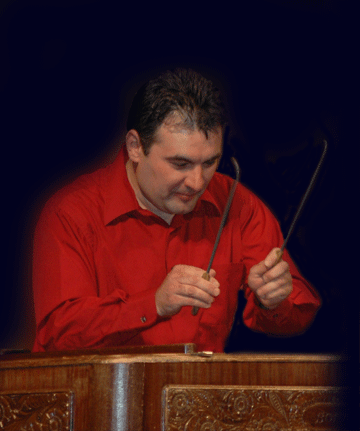 The Rocky River Chamber Music Society will explore “Chamber Music of Hungary” to begin its 61st season on Monday, October 14 at 7:30 pm at West Shore Unitarian Universalist Church.