
by Nicholas Stevens

by Nicholas Stevens

by Daniel Hathaway

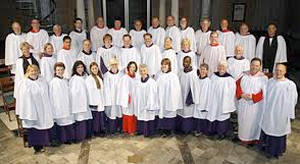
On Friday, March 30 at 7:30 pm, music director Todd Wilson will lead the Cathedral Choir, soloists, and members of Trinity Chamber Orchestra in a particularly striking setting of the Passion according to John by Estonian composer Arvo Pärt. Completed in Austria in 1982, Passio was the culmination of Pärt’s tintinnabuli style, and in many ways harks back to the liturgical passion settings of the middle ages.
In one of several near-mystical statements explaining that style of composition, Pärt wrote on his website,
Tintinnabulation is an area I sometimes wander into when I am searching for answers — in my life, my music, my work. In my dark hours, I have the certain feeling that everything outside this one thing has no meaning. The complex and many-faceted only confuses me, and I must search for unity. What is it, this one thing, and how do I find my way to it?
by Timothy Robson
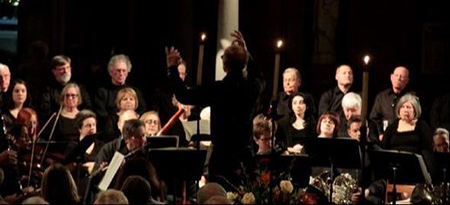
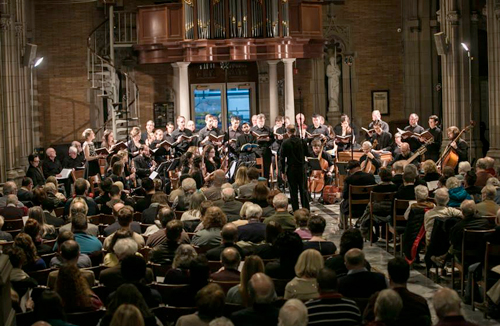
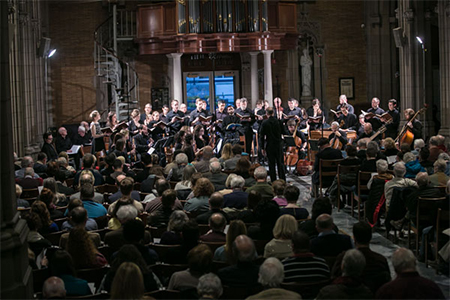
Trinity Cathedral in downtown Cleveland was packed on Friday evening for its annual Good Friday concert. This year Todd Wilson, the Cathedral’s director of music, presented Johann Sebastian Bach’s Passion According to St. John. It was musically a very fine performance, using period instruments, a chamber-sized chorus (mostly, more on that below) and a group of talented soloists who were all well-versed in historically-informed performance practices. The program booklet contained a lengthy, informative essay by musicologist Judith Eckelmeyer. [Read more…]
by Daniel Hathaway
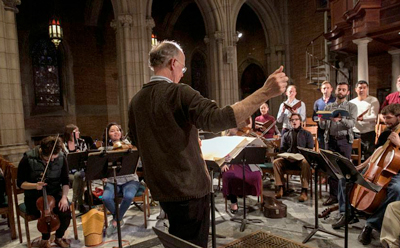
Imagine sitting in Leipzig’s St. Nicholas Church on the afternoon of Good Friday, 1724 and hearing the stirring opening chorus of Johann Sebastian Bach’s St. John Passion at its debut performance. You can re-imagine that experience this Friday — Good Friday, April 3 at 7:30 at Trinity Cathedral, when Todd Wilson will lead the Trinity Consort of 16-some singers, soloists, the Trinity Cathedral Choir, and an ensemble of period instruments in the first of Bach’s two extant settings of the story of the arrest, suffering and execution of Jesus.
“It’s a signal piece in his whole output,” Wilson said in a telephone conversation. “Its drama, its pacing, its depth of feeling. It’s extra-emblematic of everything Bach stood for, especially at that time in his life.” [Read more…]
by J.D. Goddard

by Mike Telin

At 2:00 pm in the Reid Gallery, Quire Cleveland will begin with a work from the 15th century, There is no rose, followed by Josquin des Prez’s Ave Maria, which Duffin describes as one of the composer’s iconic works. The performance continues with an extended piece in carol form from the Court of Henry VIII, Quid petis, o fili? byRichard Pygott. “It’s about Mary speaking to her child,” says Duffin. “It’s an intimate, imagined conversation and very appropriate to the Mother and Child theme.” A Spanish Christmas piece from the 16th Century, E la don don, was printed in Venice in 1556 in the Cancionero de Upsala and survives in only one copy. Duffin says it’s a lively piece that will feature solos by Quire’s male singers. [Read more…]
by Daniel Hathaway

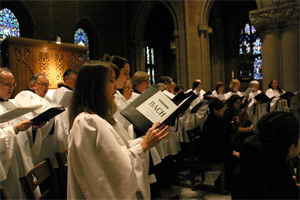
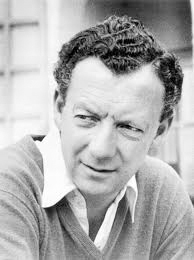
Wilson’s choral forces — Trinity Chamber Singers and the Trinity Cathedral Choir — sang the Hymn to St. Cecilia and the festival cantata, Rejoice in the Lamb, respectively, and countertenor John McElliott and tenor JR Fralick teamed with Wilson in the second of Britten’s Five Canticles, Abraham and Isaac.
The key to Britten’s renown as a vocal composer is his choice of excellent texts to set and his dead-on intuition about how to fit music to words. [Read more…]
by J.D. Goddard

In the nineteenth century it was not unusual for orchestral compositions to be arranged for piano, thus making in-home performances more readily available. Brahms completed his German Requiem in 1868, and immediately prepared a scaled down version of the work for piano four hands and chorus. It was actually premiered in a home in 1872.
This scaled-down piano version is not without interest, but those who are used to hearing the orchestral version may find it softened and somewhat bland. Though Brahms did not intend listeners to this non-liturgical requiem to shudder in fear for their souls, it is impossible not to feel a sense of guilt and veneration when lambasted by a massive chorus with full orchestra. Heard as it was this evening, this requiem became a gentler work but the intensity and emotional involvement of the singers made for a deeply religious experience. [Read more…]