
by Kevin McLaughlin

Before the trio took the stage, a handful of instrumental and vocal performers drew welcome attention to non-brass works by Nicholas Puin, Matthew C. Saunders, Margaret Brouwer, and Andy Junttonen.
by Kevin McLaughlin

Before the trio took the stage, a handful of instrumental and vocal performers drew welcome attention to non-brass works by Nicholas Puin, Matthew C. Saunders, Margaret Brouwer, and Andy Junttonen.
by Kevin McLaughlin

It was a double privilege, then, to experience the Jazz at Lincoln Center Orchestra with Wynton Marsalis in EJ Thomas Hall on Saturday, April 20. First, to hear the JLCO again in Akron “after forty years” (according to Marsalis), and second, to hear this ensemble perform the Ellington book at the very highest level of technical skill and as mindful stewards of jazz tradition.
by Kevin McLaughlin

It was this sort of unaffected honesty that Polenzani brought to the Cleveland Chamber Music Society at Disciples Christian Church on Tuesday, April 9, in a recital program of Schubert, Schumann, Finzi, and Ives. Out of keeping with the series’ regular fare of string quartets and instrumental chamber music, the freshness was doubly felt.

Originally published on Cleveland.com
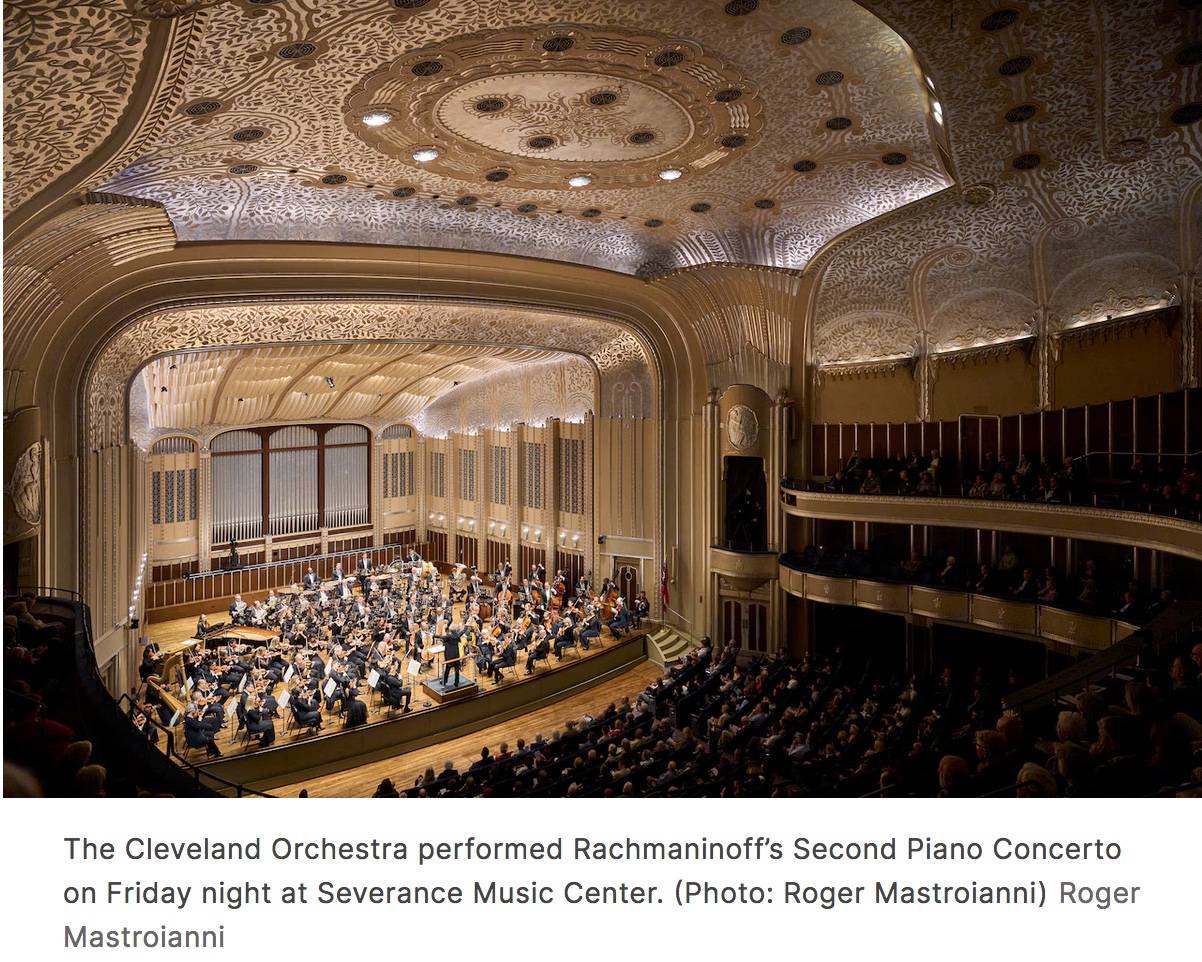
CLEVELAND, Ohio — Two forest-themed works and a picture of a noir-suffused city that never sleeps formed a riveting Cleveland Orchestra program on Thursday evening April 4 in Mandel Concert Hall at Severance Music Center under the direction of guest conductor John Adams.
A good way to convince someone to care more about trees is to take them on a hike. American naturalist John Muir, who hiked with common folk and presidents alike, encouraged everyone to “climb the mountains and get their good tidings.”
Another way is to bring the trees to the people. Gabriella Smith did just that with Breathing Forests, her mesmerizing 30-minute organ concerto, composed in 2021 for James McVinnie, who was soloist on Thursday.
As a whole, Mozart’s Requiem is a grandiose work, sublime in its evocation of salvation and eternal rest, and fearsome in its visions of the Last Judgment. The grand forces that meet the eye — four soloists, chorus, and orchestra — suggest drama and spectacle, even if the scoring is dark: the lighter hues of flutes and oboes are omitted in favor of basset horns (cousins of the clarinet), bassoons, a choir of trombones, and strings in their lower registers. Even trumpets and timpani are used less for their ceremonial qualities than as emulsifiers of the texture.
by Kevin McLaughlin

In each of the twelve movements Richter brings Vivaldi in and out of focus by isolating and repeating melodic fragments against an attenuated accompaniment. In the slow movements more of the melody is preserved — the Largo in “Winter” for example — but the original harmonic framework is altered. [Read more…]
by Kevin McLaughlin

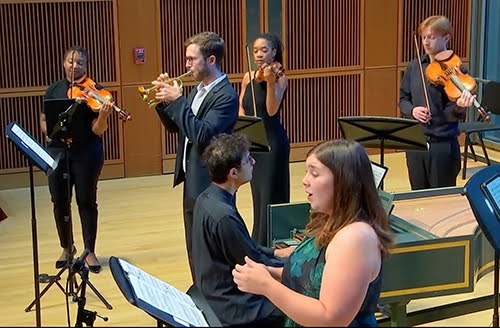
Their most recent show, “Hispania, a Voyage from Spain to the Americas,” is ostensibly an excursion by sea through sixteenth-century Spain and Latin America in ballades, dances, and instrumental fancies. But where another period ensemble might have rowed their boat with deliberate and reverential strokes, Jeannette Sorrell and her joyous troupe made this trip a theatrical thrill ride. I attended the performance at St. Rocco Parish on March 21.
by Kevin McLaughlin

A pre-concert panel — which brought together Oberlin faculty members with the Imani Winds’ Monica Ellis and Chamber Music Detroit’s Bryan Jones — helped frame the music to come. Jeff Scott’s Fallen Petals of Nameless Flowers, an unflinching look at the U.S. criminal justice system historically misapplied to young men of color, served as the emotional and consequential center of the program, and the through-line of the discussion.
Jody Kerchner shared her activity as Director of the Oberlin Music at Grafton Choir, playing excerpts of music written and performed by its incarcerated members while they listened in real time on a livestream.
By Kevin McLaughlin, Cleveland Classical
Originally published in Cleveland.com

The Concerto No. 27 in B-flat, K. 595 — Mozart’s last — was composed in 1788, though not performed until March of 1791. Many keyboard players like to ascribe to Mozart the same pathos that attached itself to Schubert in his final years of life, but Ohlsson knows better. Mozart’s music rarely reflects immediate personal crises, and this particular concerto wasn’t designed for that anyway. (Photo by Yevhen Gulenko)
by Kevin McLaughlin

Several contemporary composers (Claudia Hinsdale, Jeff Scott, Joshua Estok, Andrew Rindfleisch, and Caroline Shaw) honored old masters — and did themselves honor in return — in a satisfying program of pairings on Saturday, March 2, at the First Lutheran Church of Lorain. Artistic director Gregory Ristow and the exceptional voices of the Cleveland Chamber Choir were their co-travelers in time.
As one of the earliest examples of a composer referencing an older style, Crucifixum in carne (probably by Medieval composer Pérotin, looking back at the anonymous original) served as an appropriate introduction. Here, the old was intertwined with the new as an elongated cantus firmus undergirded fancy new polyphony. Sung by thirteen unaccompanied male voices led by assistant conductor Peter Wright, the piece resonated warmly in the sanctuary.